
Crony Capitalism
Why the system of modern day capitalism is not the real deal

The unease is widespread about capitalism right now. There is talk of fairness, special treatment to big companies, insufficient competition and an excessive amount of power in the hands of a few individuals. But peeking beneath the surface of “capitalism,” there is much that isn’t strictly speaking capitalism. It’s crony capitalism which is a system based on connections and political favours and not based on free choice or open deals. It’s more than a semantic error to mix the two. It obscures the political debate and allows the people really perpetrating the economic issues to get off the hook.
Capitalism is based on one fundamental principle: People can own things, and the ownership is respected. Markets are free to adjust. Prices are the result of people’s preferences and availability of supplies, which indicate scarcity and value. Profits demonstrate that resources are being used in a manner which people enjoy, losses demonstrate the opposite and induce change. The protection of political friends is not provided and new ideas push out old ideas. It is the state’s role to narrow its responsibilities but to fulfil their duties to enforce contracts, protect property and prevent force and fraud. Everything else is left to voluntary cooperation of people. The objective should be to enlarge the entire economy via better ideas and not politics.
Things are different in crony capitalism. Companies prosper for proximity to power. They are rewarded with subsidies, special tax loopholes, laws enacted to their benefit, special licenses, or tacit assurances of success. The key to winning is not necessarily better products or lower prices, it’s lobbying and who you know. Normal mechanism of profit and loss fails: losses are socialised, profits remain private. The state is left with the problem of selecting winners and losers, which is not a problem a true free market of voluntary exchange would have.
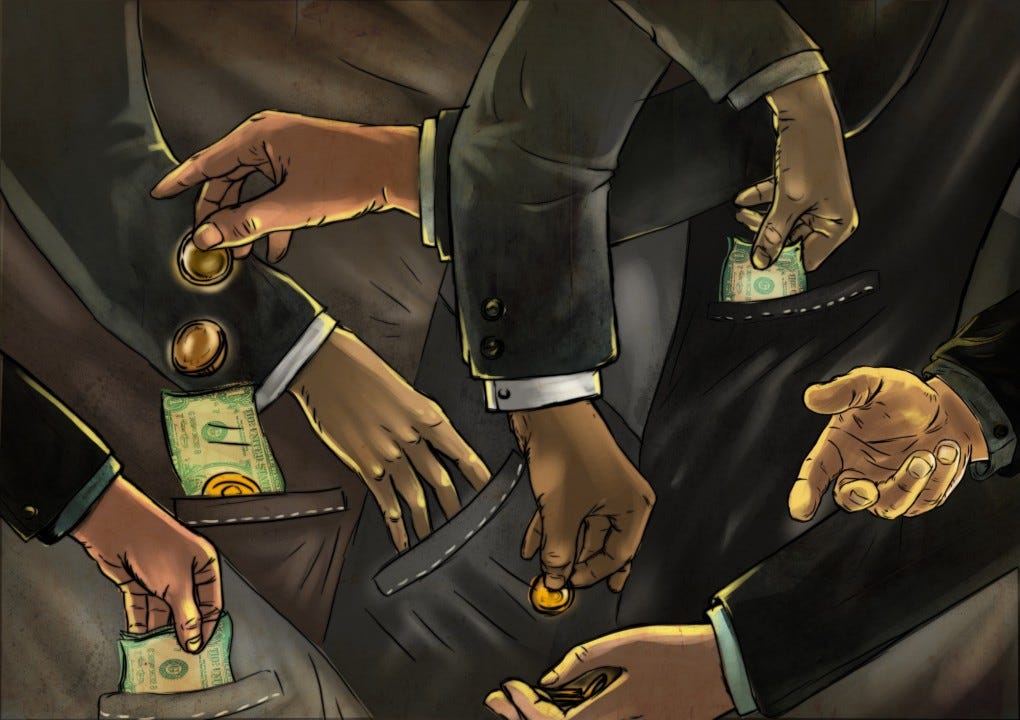
This difference is evident when it comes to practice. In an open market, poorly run companies go under and their capital and workers move to better uses. Companies thrive on their customers. Politically connected companies are protected from that pressure in a crony system. Resources remain bound in unproductive locations. Barriers are given in front of new participants. Energy is diverted away from pleasing customers, and towards pleasing officials. Innovation slows. Inequality actually increases the more the value is increased by some people because there are some who get artificial advantages.
There are examples aplenty. For years the American sugar industry enjoyed artificially high prices thanks to quotas and subsidies. Billions more were paid by US consumers annually than the world price, and a small number of producers enjoyed the benefits. For many years, Fannie Mae and Freddie Mac were given a tacit government guarantee which kept them borrowing at lower rates and allowed them to dominate the mortgage market. In 2008, that assurance was put to the test and taxpayers footed the bill. Large financial institutions that were deemed “too big to fail” were supported in ways that shielded their financial institutions from failure, which would have been the fate of any other company.
Recent British experience suggests this too. During the pandemic a special procurement channel was created for medical supplies. There was a significant link between winning contracts and having political connections, with firms having these connections being more likely to secure contracts. Expensive items were bought and not used and a few well-established businesses prospered. The Greensill Capital episode further complicated the picture: it seemed as if access to government-backed finance was linked to former political figures, leading to uncomfortable questions about where the legitimate influence stops and the preferential treatment begins.
All this is not the product of the “capitalist logic. It’s based on the scale and scope of government power. The state that spends the money, bestows the license, issues detailed regulations, or takes a selective action establishes valuable privileges. Rational people will be fighting for those privileges, rather than just for customers. The more the government gets involved in the economy, the more energy is diverted from product and process improvement to politics. That’s not a market failure. It’s the logical outcome of selling political power.
The damage compounds. If people are seeing win-wins that appear to be “rigged”, they lose faith in the markets. Losing that trust leads to greater demands for more intervention, leading to even more opportunity for favouritism. Sometimes “capitalism” is used to denote systems that are not capitalistic. Normal businesses without political patronage have to pay more and be given less opportunities. The economy gradually turns into a “who knows” business.
The first step to the remedy is clear thinking. Real capitalism doesn’t mean no government. It implies limited, predictable and equal government. Rules must be general and known to be in advance, not “made up” for the favourites. Any public contracts should be subject to open competition. Any implicit guarantees should be removed to ensure proper pricing of risk. All a policy has to do is to increase the range of freedom of voluntary decision, or to award benefits based on political affiliation.
Some critics, who attach importance only to the size of large companies, or the wealth of successful entrepreneurs, lose sight of this difference. Serving customers is a size and wealth measure that is consistent with capitalism. Subsidy, rule of thumb, or government bailout are not size nor wealth. Similarly, people who say that all the rich people are born of pure capitalism, fail to understand the nature of the system and its nature.
In most of the rich countries today we live with a combination of the two. The first step in the direction of clear diagnosis is to no longer consider them as the same. Many of the things that are now being touted as “capitalism failing” are precisely what’s happening when the actual system is continually substituted by its political counterpart. Until this difference is maintained in the public eye, the public debate will continue to focus on symptoms and not on causes.