
Neoliberlism
From marginal theory to the air we breathe

To understand the modern world is to understand Neoliberalism. It is the invisible architecture of our age, the quiet logic that governs everything from your local water bill to the way you view your own career. It is not just “capitalism”; it is a specific, aggressive mutation of it that reshaped the globe over the last fifty years.
But where did it come from, and why does it feel like the walls are closing in?
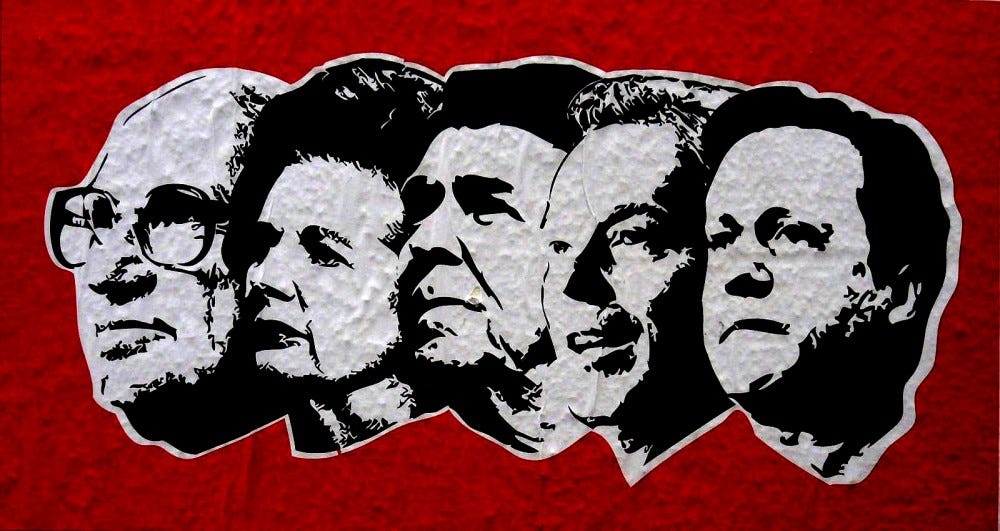
The Alpine Genesis: Mont Pèlerin, 1947
Neoliberalism was not an accident. It was a deliberate intellectual insurgency. In the wake of World War II, as the West embraced the “Cradle to Grave” welfare state and Keynesian economics, a small group of thinkers met in Switzerland.
Led by Friedrich Hayek and later championed by Milton Friedman, the Mont Pèlerin Society believed that any state intervention in the economy was a slippery slope toward totalitarianism. Their manifesto was simple: the market is the only true source of freedom.
They spent decades in the wilderness, funded by wealthy patrons, building a network of think tanks and academic departments. They waited for the post-war consensus to fail. In the 1970s, when “Stagflation” (high inflation plus stagnant growth) hit, they were ready with a pre-packaged solution.
The Three Pillars of the Faith
When Margaret Thatcher and Ronald Reagan took power, the neoliberal laboratory went live. The doctrine rests on three non-negotiable pillars:
Privatisation: The belief that the private sector is inherently more efficient than the public. This led to the sell-off of state assets, from British Rail to national energy grids.
Deregulation: The removal of “red tape,” particularly in the financial sector. This paved the way for the explosive growth of Wall Street and the City of London.
The Death of the Collective: As Thatcher famously put it, “There is no such thing as society”. Unions were crushed, and the burden of risk was shifted from the state to the individual.
Neoliberalism Today: The Marketisation of the Self
In 2026, we are living in the “Late Stage” of this experiment. Neoliberalism has moved beyond economics and into our psychology. It manifests today in ways the original architects might not have even imagined:
The Gig Economy: We are no longer employees; we are “entrepreneurs of the self”. Your car is a taxi, your spare room is a hotel, and your free time is a side hustle. This is the ultimate neoliberal triumph: total flexibility for capital, total insecurity for the worker.
The Metrics of Everything: We treat our lives like a balance sheet. We track our sleep, our “personal brand”, and our social capital. If the market is the only measure of value, then anything that cannot be monetised, leisure, community, quietude, becomes “waste”.
The Technocratic Trap: Today, political debate is often reduced to “management”. Major decisions are outsourced to “independent” central banks and unelected trade bodies, removing the economy from the reach of democratic voting.
The Cracks in the Facade
The irony of the neoliberal era is that it promised competition but delivered monopoly. By deregulating markets, we allowed “too big to fail” giants to eat their competitors. By prioritising the movement of capital over the movement of people, we created the greatest wealth gap since the Gilded Age.
The ghost of the Mont Pèlerin Society still haunts our halls of power, but the spell is breaking. From the return of industrial policy to the rising demand for “Universal Basic Services”, the world is beginning to realise that the market is a wonderful servant, but a hollow god.