
The Dragon Portfolio
The key to continued account growth in a time of volatility

The Dragon Portfolio was created by Christopher Cole, Chief Investment Officer of Artemis Capital Management, in his 2020 research paper titled “The Allegory of the Hawk and the Serpent”.
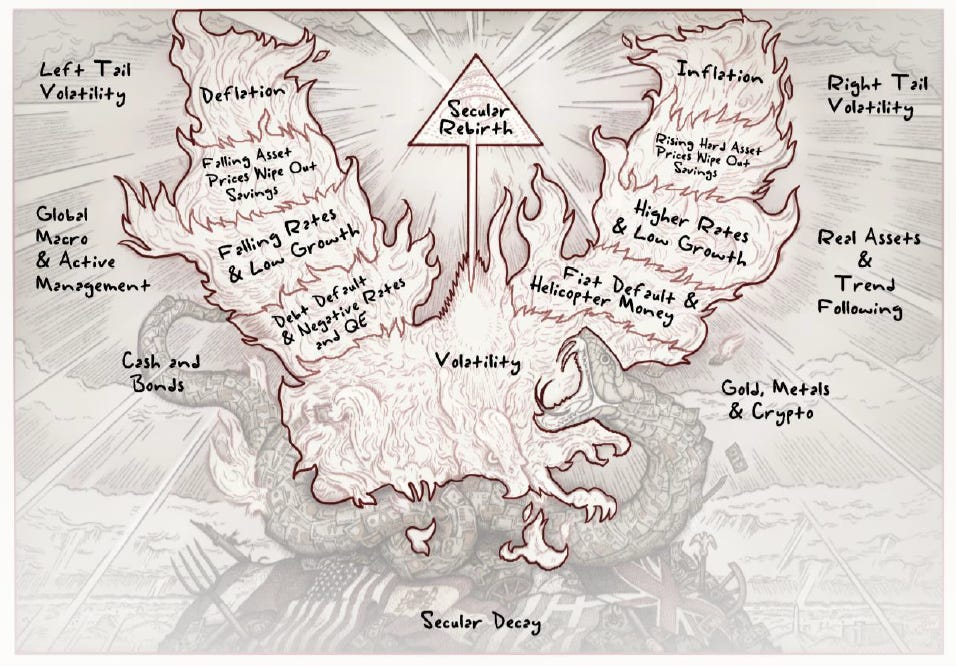
The Origin Myth (The Allegory)
Cole uses a metaphor to explain why traditional portfolios (like the 60/40 stock-bond split) are vulnerable:
The Serpent: Represents periods of secular growth, stability, and globalization (bull markets). Most investors thrive here but are “blinded” by recent success.
The Hawk: Represents periods of “creative destruction”, such as hyper-inflation or deflationary crashes. These periods destroy the “Serpent” but happen rarely enough that people forget to prepare for them.
The Dragon: A mythical creature that combines the features of both. The Dragon Portfolio is designed to thrive in both environments, aiming to protect and grow wealth over a 100-year cycle regardless of which “regime” dominates.
Why it was created
Cole argued that the last 40 years were an anomaly of falling interest rates and steady growth. He believed that traditional diversification would fail when stocks and bonds began moving in the same direction (e.g., during high inflation). The Dragon Portfolio uses Long Volatility and Commodity Trend Following, assets that usually perform best when everything else is crashing, to act as a counter-balance.
The Original Allocation (~20% each)
Equity (Stocks): For growth during “Serpent” years.
Fixed Income (Bonds): For protection during deflation.
Gold: For protection during fiat devaluation/inflation.
Commodity Trend Following: To capture large moves in raw materials.
Long Volatility: To profit from market chaos and “tail risk” events.
Our modern take on the Dragon Portfolio, for 2026
1. The Growth Engine (Equity) 24%
These remain the cornerstone for global equity exposure and are highly active in 2026. SPDR MSCI World UCITS ETF (Ticker: SWRD / SWLD): This is the primary vehicle for 19.2% of your 24% equity allocation. It is a massive, liquid fund with an ultra-low expense ratio (0.12%). For the remaining 4.8% we would recommend Xtrackers MSCI Emerging Markets ex China UCITS ETF (Ticker: EMXC).
2. The Defensive Ballast (Fixed Income) 18%
To build the Defensive Ballast of a Dragon Portfolio (roughly 18% total), you allocate 9% to iShares $ Treasury Bond 20+yr (IDTL/IBTL) for maximum crash protection due to its high interest-rate sensitivity, 4.5% to iShares Global Corporate Bond (CRPH/GCRP) to capture higher yields from quality companies while using currency hedging (EUR or GBP) to minimize volatility, and 4.5% to iShares J.P. Morgan $ EM Bond (JPEA/IEMB) to diversify into emerging market debt for boosted income. Collectively, these iShares ETFs act as a “safe haven” anchor, designed to maintain liquidity and gain value when equity markets underperform or collapse.
3. Real Wealth (Gold) 19%
Gold is the “Dragon’s” insurance policy against currency debasement.
WisdomTree Physical Swiss Gold (Ticker: SGBX or GZYS): This covers the 19% gold allocation. It is backed by physical gold bars held in secure Swiss vaults.
4. The Inflation Hedge (Commodity Trend) 18%
This is the most complex section. SEB Asset Selection Fund C (Ticker: LU0256624742): This fund is managed by SEB in Luxembourg. It uses a systematic “trend-following” approach to profit from rising commodity prices.
5. The Insurance Policy (Long Volatility) 21%
VIXM (ProShares VIX Mid-Term Futures ETF): Tracks the “fear index” further out on the curve to reduce the “bleed” of holding it.
Conclusion: Investing for the Long Cycle
The Dragon Portfolio represents a fundamental shift from “chasing returns” to “surviving regimes”. By moving away from the fragile 60/40 model and embracing assets like Long Volatility and Commodity Trend Following, this strategy acknowledges that the economic stability of the past 40 years is not guaranteed for the next 40. Whether the future brings the steady growth of the Serpent or the chaotic destruction of the Hawk, the Dragon Portfolio provides a mathematically grounded framework to protect purchasing power and capture growth. In 2026, using accessible tools like iShares ETFs, WisdomTree physical gold, and systematic funds, retail investors can finally implement a sophisticated “100-year” strategy that was once reserved only for the world’s most elite institutional players.