
The Fabian Manifesto
Gradualism as the Stealth Engine of Collectivism

The Fabian Society, established in London in 1884, represents one of the most enduring and effective vehicles for the advancement of socialist principles in the Anglo-Saxon world. Unlike the fiery revolutionaries who dominated continental socialism, the Fabians adopted a strategy of patient infiltration and incremental reform. Their approach, inspired by the Roman general Fabius Maximus Cunctator, emphasised delay and attrition over direct confrontation. This calculated gradualism has allowed their ideas to permeate institutions with remarkable success, often escaping the scrutiny reserved for more overt ideological movements.
The seminal Fabian Essays in Socialism, published in 1889 and edited by George Bernard Shaw, crystallised their programme. Contributions from Shaw, Sidney Webb, Beatrice Webb, and others outlined a vision of society transformed not through barricades but through the steady expansion of state control, municipal ownership, and bureaucratic administration. The essays presented socialism as the logical evolution of democracy and industrial organisation, framing it as both inevitable and morally superior.
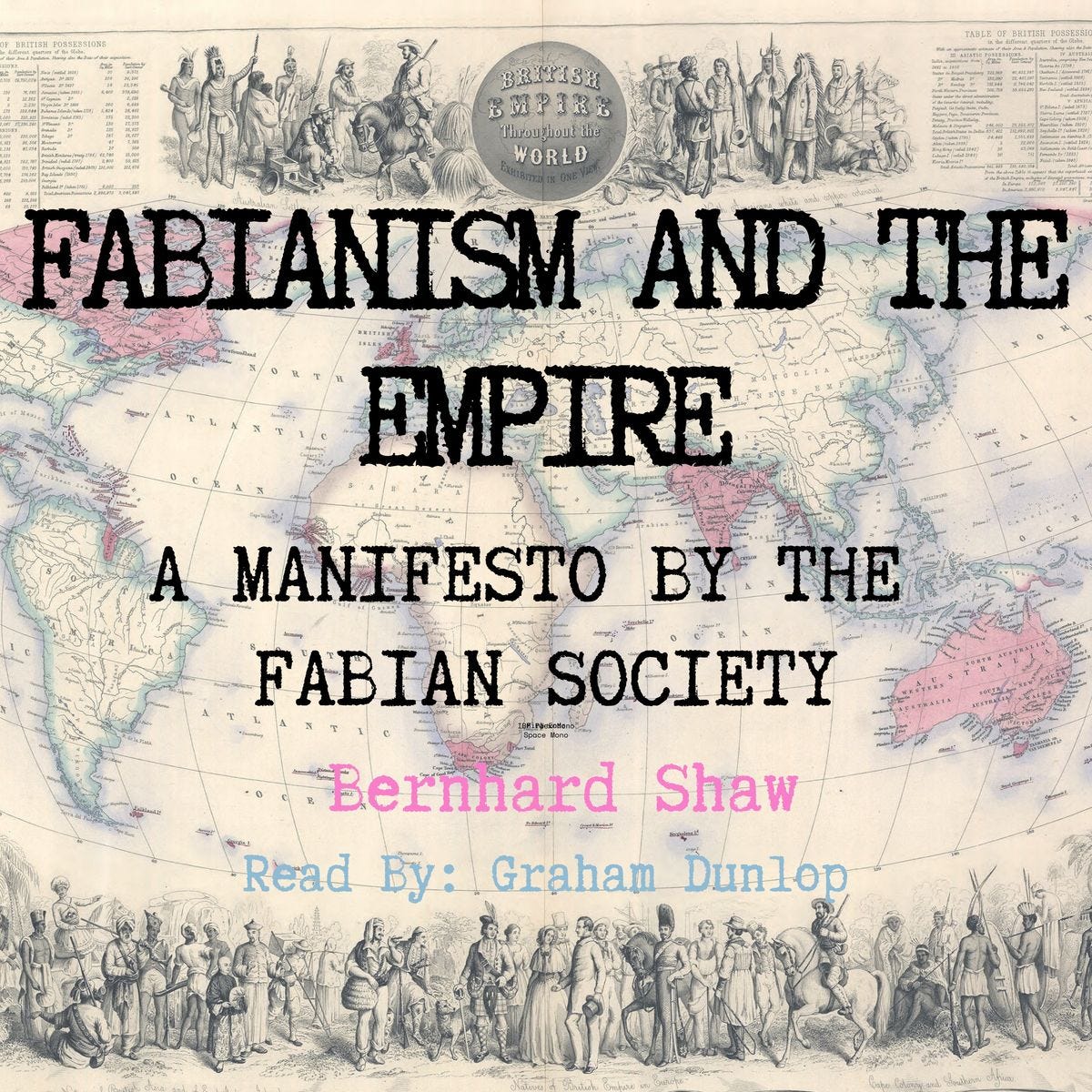
The Core Tenets of Fabian Thought
At the heart of the Fabian manifesto lies a rejection of laissez-faire capitalism in favour of collective ownership of the means of production. The Fabians argued that private property in land and capital created inherent inequalities that democratic government must redress. Sidney Webb’s essay “Historic” portrayed the growth of public services and regulatory oversight as unconscious steps toward socialism, suggesting that Britain was already drifting in this direction.
Shaw and his colleagues advocated “permeation”: the systematic placement of sympathetic individuals within universities, the civil service, the press, and political parties. They sought not violent upheaval but the quiet capture of existing structures. This strategy proved extraordinarily effective. The Society played a pivotal role in the formation of the Labour Party, the establishment of the London School of Economics, and the intellectual groundwork for the post-war welfare state. Over two hundred Labour Members of Parliament elected in 1945 held Fabian affiliations.
Their approach distinguished itself from Marxist orthodoxy by embracing parliamentary democracy and evolutionary change. Yet this moderation masked a radical endgame: the eventual supersession of private enterprise by public control, justified in the name of efficiency, equality, and social justice.
Economic and Social Consequences
From a critical perspective, the Fabian project has contributed to the steady erosion of individual economic liberty in Britain and beyond. The expansion of the state apparatus, progressive taxation, nationalised industries, and comprehensive welfare provisions followed the intellectual path laid in those late-Victorian essays. Proponents claim these measures delivered greater fairness and stability. However, the record reveals persistent challenges: diminished incentives for innovation and capital formation, bloated bureaucracies resistant to reform, and intergenerational fiscal burdens.
The Fabians’ influence extended to education and culture. By shaping elite institutions, they ensured that subsequent generations of administrators, journalists, and politicians internalised collectivist assumptions. The result has been a political consensus favouring ever-larger government, even across nominal party lines. Policies once considered radical have become embedded features of the administrative state.
Critics have long noted the paternalistic undertones. The Fabians, drawn predominantly from the educated middle and upper classes, viewed the working population as beneficiaries of enlightened administration rather than sovereign individuals. This technocratic mindset persists in contemporary debates over central planning, net zero targets, and expansive social programmes.
The Enduring Legacy in the Twenty-First Century
More than a century later, the Fabian approach continues to shape British and international discourse. Gradualism has allowed ideas of wealth redistribution, regulatory oversight, and public ownership to advance with minimal resistance until entrenched. Recent policy discussions around “good growth” and “good society,” with their emphasis on state-orchestrated sustainability and equity, echo the original manifesto’s blend of economic control and moral rhetoric.
This stealthy methodology presents a particular challenge to those who value classical liberal principles. Unlike revolutionary socialism, which provokes clear opposition, Fabian gradualism operates through compromise and incremental legislation. Each new layer of intervention appears reasonable in isolation, yet the cumulative effect restructures society toward collectivism.
Observers concerned with fiscal sustainability, personal responsibility, and economic dynamism would do well to recognise this pattern. The welfare expansions, monetary experiments, and regulatory proliferation of recent decades reflect the long victory of Fabian thought, even where the Society itself maintains a lower profile.
Conclusion: A Call for Vigilance
The Fabian Manifesto did not announce a sudden revolution but engineered a patient transformation. Its authors understood that ideas, once embedded in institutions and accepted as common sense, exert influence far beyond any single election. Britain’s political economy bears the imprint of this strategy: a mixed system in which private enterprise persists under increasing constraint, and the state assumes responsibility for outcomes once left to individuals and markets.
Whether this trajectory serves the long-term interests of prosperity and liberty remains a matter of profound debate. History demonstrates that centralised control often fails to deliver the efficiency and equity promised by its advocates. As fiscal pressures mount and productivity stagnates in many advanced economies, a reassessment of the foundational assumptions introduced by the Fabians becomes not merely academic but essential.
The quiet persistence of these ideas underscores the need for renewed defence of limited government, property rights, and individual agency. Only through clear-eyed analysis of their origins and outcomes can societies hope to recalibrate the balance between collective provision and personal freedom. The Fabian legacy endures not because of dramatic upheaval, but precisely because it avoided it. That subtlety remains its greatest strength and, for its critics, its most formidable challenge.