
The Hunt Brothers
A primer on hubris, margin calls, and the ghosts of 1980

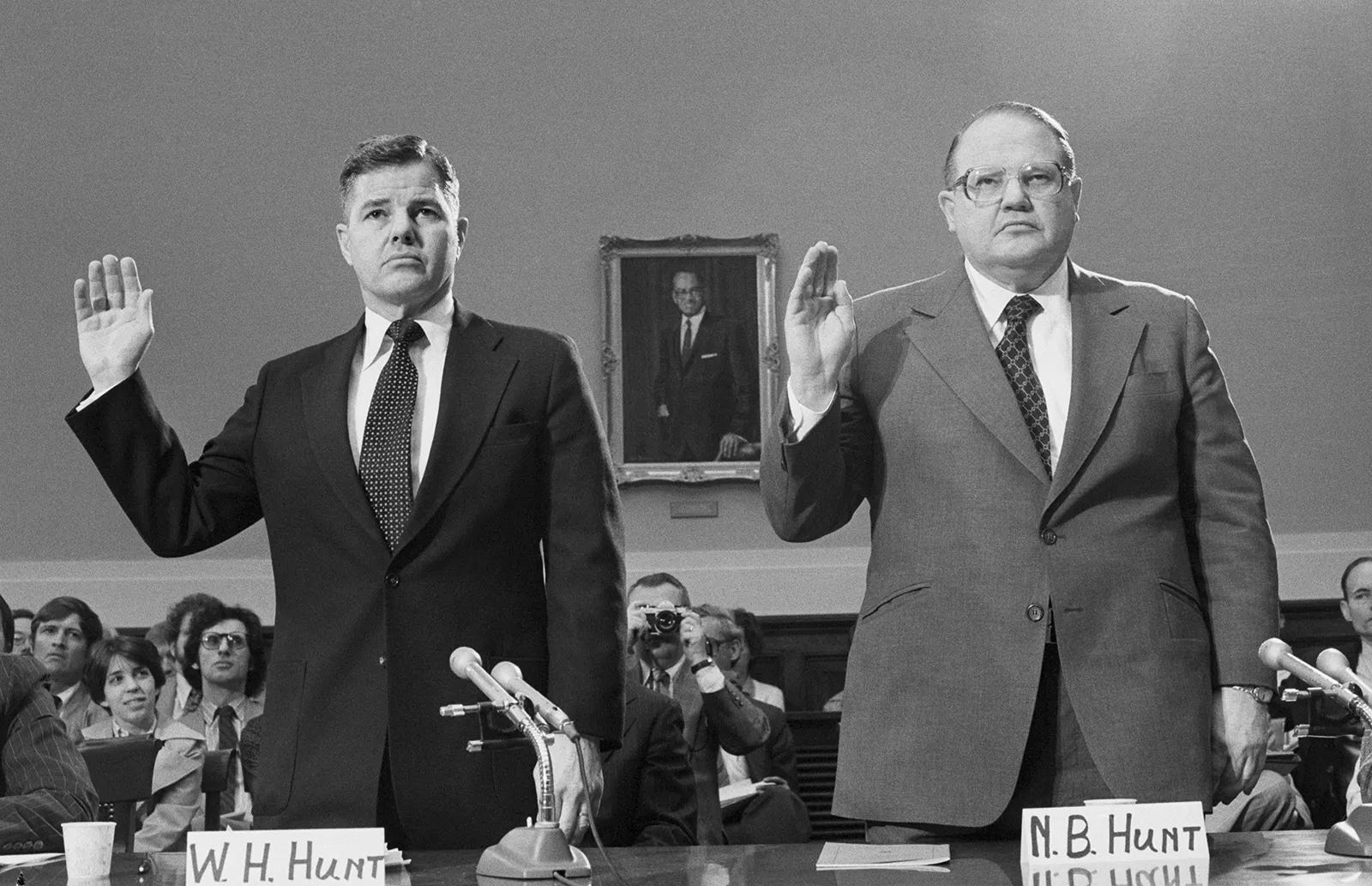
The year was 1979. The backdrop was an era of double-digit inflation, a staggering energy crisis, and a profound distrust in fiat currency. While the masses were distracted by the neon flicker of the coming decade, two brothers from Texas, Nelson Bunker Hunt and William Herbert Hunt, decided to stage a coup against the global financial establishment.
Their weapon of choice? Physical silver.
The Mechanics of the Corner
The Hunt brothers didn’t just speculate. They accumulated. By early 1980, the duo, alongside a consortium of Saudi investors, reportedly controlled approximately 200 million ounces of silver. That represented roughly half of the world’s deliverable supply.
They weren’t playing with paper slips in a digital vacuum. They were taking physical delivery. They were hauling bars to vaults in Switzerland by the planeload. As the supply vanished, the price responded with a vertical ascent that defied gravity.
January 1979: Silver trades at around $6.00 and ounce.
January 1980: Silver touches an intraday high of roughly $50.00 and ounce.
The establishment was backed into a corner. When the “wrong” people start winning the game, the referees usually decide to change the rules.
Silver Thursday: The Empire Strikes Back
The Hunt brothers were long, but they were also leveraged. This was their Achilles’ heel. Sensing a systemic threat to the commodity exchanges, the COMEX governors implemented “Silver Rule 7”. This emergency measure restricted trading to liquidation only. You could sell, but you couldn’t buy.
The demand vanished overnight. On 27 March 1980, now immortalised as Silver Thursday, the price collapsed. As the value of their collateral evaporated, the Hunts were hit with margin calls they couldn’t meet. The panic that followed didn’t just ruin the brothers; it sent ripples through the entire brokerage industry.
The Modern Echo: History Rhyming in Real Time
Fast forward to the present day. While the names have changed, the structural vulnerabilities of the market remain suspiciously familiar. We see the same ingredients that cooked the 1980 collapse simmering again.
The Trust Deficit: Just as the Hunts feared the devaluation of the dollar, modern investors are eyeing the relentless expansion of central bank balance sheets with growing alarm.
The Paper vs. Physical Disconnect: In 1980, the Hunts exposed the fact that there were far more “paper claims” on silver than actual metal in the vaults. Today, the ratio of paper trading to physical bullion remains an elephant in the room.
The Decentralised Hunt: We no longer need two billionaires to corner a market. The rise of retail coordination via social media platforms has created a “distributed Hunt brother” effect. When thousands of smaller players decide to stack physical metal simultaneously, the liquidity drain is just as real.
The Final Word
The lesson of 1980 isn’t that silver is a bad bet. The lesson is that the “House” has a low tolerance for being outmanoeuvred. When the Hunts threatened the integrity of the pricing mechanism, the mechanism was simply turned off.
In an era of “circuit breakers” and “buy button” removals, the modern investor must ask a simple question: If you don’t hold the physical asset in your hand, do you actually own it when the music stops?
The Hunt brothers learned the hard way that leverage is a double-edged sword, especially when your opponent owns the whetstone.