
The Managerial Revolution
Who really runs the world?

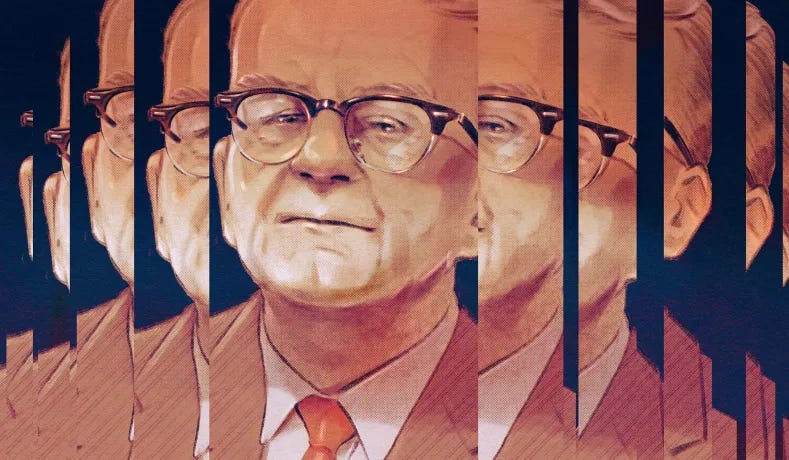
In 1941, as the world was engulfed in a clash of “isms”, Fascism, Communism, and Capitalism, a former Trotskyist named James Burnham published a book that quietly rendered the entire debate obsolete. He called it The Managerial Revolution.
Burnham’s thesis was simple but devastating: the era of the “Owner-Capitalist” (the Henry Fords and Rockefellers) was dead. So, too, was the dream of the “Proletarian Revolution.” In their place, a new, third class was seizing the levers of power. He called them The Managers. In 2026, we aren’t just living in Burnham’s world; we are living in its final, most bloated stage.
The Death of the Owner
In the early days of capitalism, the man who owned the factory ran the factory. He took the risks, he reaped the rewards, and he held the “sovereignty” of the business.
But as corporations grew to a scale beyond the comprehension of a single human mind, a divorce occurred. The separation of ownership and control became the defining feature of the 20th century. Ownership became dispersed among millions of anonymous shareholders, while the actual power to make decisions shifted to a professional class of “technical experts”, executives, administrators, and bureaucrats.
These managers don’t own the wealth they control. Instead, they derive their power from their position within the hierarchy. Their goal isn’t necessarily “profit” in the old-fashioned sense; it is the perpetuation and expansion of the organisation itself.
The Rise of the Managerial State
This revolution wasn’t confined to the boardroom. It colonised the government as well.
Burnham predicted that the distinction between “Government” and “Business” would eventually vanish. Today, we call this the “Administrative State” or the “Deep State”. It is a vast, unelected layer of permanent officials who remain in power regardless of who wins an election.
The Technocratic Shield: Major policy decisions are no longer debated in the public square; they are “managed” by “independent” experts at central banks, health organisations, and trade bodies.
The Managerial Credo: The manager views the world as a series of technical problems to be solved through “efficiency,” “metrics,” and “compliance.” Human values, tradition, faith, and local identity, are seen as “friction” in the system.
2026: The Managerial Enclosure
As we move deeper into the 2020s, the Managerial Revolution has reached its logical conclusion: The total administration of life.
We see this in the rise of “ESG” (Environmental, Social, and Governance) scores. This is the ultimate managerial tool. It allows the professional class to bypass the messy democratic process and enforce social policy directly through the financial system. If you want to know why every major corporation seems to speak the same “woke” dialect, it isn’t because they’ve had a moral epiphany; it’s because the managerial class shares a unified cultural and educational background. They are the “citizens of nowhere” whose primary loyalty is to the global managerial consensus.
The “Managerial” Individual
We have even started to manage ourselves. We track our sleep, our steps, and our social capital with the same cold detachment a middle manager uses to review a quarterly spreadsheet. We have turned our very existence into an “organisation” to be optimised.
The Final Word
The “unreason” of our current era is the belief that we are still living in a democracy or a free market. In reality, we are living in a Managerialism.
The struggle of 2026 is not “Left vs. Right”; it is the Managed vs. the Managers. It is the struggle of the individual, the small business owner, and the local community to reclaim their sovereignty from a professional class that views them as mere data points to be “allocated”.
Burnham warned that the managers would eventually create a society that is “totalitarian in a new and subtle way”. As the algorithm (pun intended) replaces the ballot box and “compliance” replaces “freedom”, his prophecy feels less like a warning and more like a post-mortem.