
The New Luddites
AI and the Recurring Spectre of Technological Displacement

The Luddites of early nineteenth-century England have long been dismissed as mere reactionaries, fearful men who smashed textile machinery in a futile bid to halt progress. Yet their story resonates with uncomfortable clarity in the present age of artificial intelligence. As AI systems advance at a pace that outstrips even the most optimistic forecasts, a growing chorus of voices warns of widespread job losses, economic upheaval, and social fragmentation. The correlation between the Luddite rebellions and today’s anxieties over AI is not superficial. Both represent moments when technological innovation collides with the lived realities of labour, revealing deep tensions in how societies absorb and distribute the fruits of progress.
The Luddite movement emerged in the 1810s amid the Industrial Revolution. Skilled artisans in the textile trade faced the introduction of mechanised looms and frames that could be operated by cheaper, less experienced workers. Output soared, but wages plummeted and unemployment spread. The Luddites, taking their name from the possibly mythical Ned Ludd, responded with organised destruction of machinery, strikes, and petitions to Parliament. Their actions were not born of blind opposition to technology itself, but of a rational defence of their livelihoods, communities, and the dignity of skilled work. The British government responded with force, deploying troops and passing harsh legislation that made machine-breaking a capital offence. Many Luddites were executed or transported.
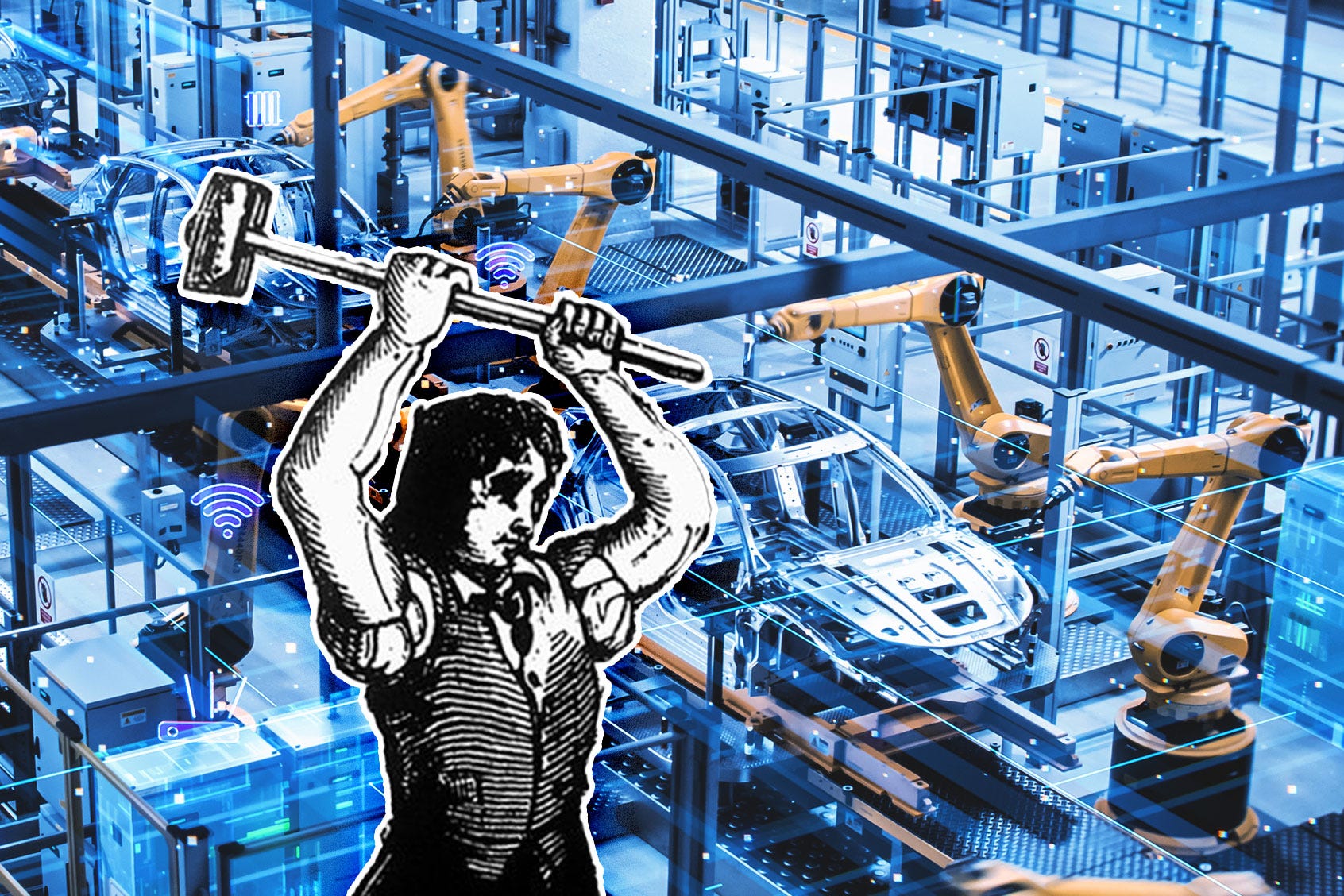
This historical episode offers a stark parallel to the current trajectory of artificial intelligence. Just as the steam-powered loom displaced weavers, large language models, generative algorithms, and autonomous systems now threaten a broad swathe of white-collar and creative professions. Coders, journalists, lawyers, analysts, designers, and even radiologists find their domains encroached upon by tools that perform tasks faster and at lower marginal cost. Unlike the narrow focus of early industrial machinery, AI exhibits a generalist quality, capable of adapting across sectors. The result is a profound acceleration of creative destruction, but one whose destructive element appears particularly acute.
Economic data underscores the scale of potential disruption. Productivity gains from AI are concentrated in the hands of a small number of technology firms and their investors, while the broader workforce confronts uncertainty. Reports from leading consultancies and central banks project significant occupational displacement over the coming decade, with certain estimates suggesting that up to a third of tasks in advanced economies could be automated. Wages for routine cognitive work may stagnate or decline, exacerbating existing inequalities. The owners of capital and intellectual property in AI reap disproportionate rewards, much as mill owners profited handsomely during the Industrial Revolution while displaced workers bore the adjustment costs.
The correlation extends beyond economics into the realm of social and political response. Contemporary critics of unchecked AI deployment, sometimes labelled “neo-Luddites”, advocate for pauses in development, stricter regulation, or mechanisms to redistribute gains through taxation or universal basic income. Their concerns mirror those of the original Luddites: the erosion of human agency, the deskilling of labour, and the risk that technological change serves elite interests at the expense of social cohesion. Governments and corporations, meanwhile, echo the early nineteenth-century establishment by emphasising inevitable progress and the necessity of adaptation. Public policy discussions frequently frame resistance as irrational, yet history suggests such resistance often signals genuine grievances that, if ignored, can fuel instability.
There are, of course, important distinctions. The Luddites confronted machines of limited scope, whereas AI promises augmentation as well as replacement. Proponents argue that new roles will emerge, just as the Industrial Revolution eventually generated unprecedented wealth and living standards. Yet this long-term optimism offers scant comfort to those facing immediate dislocation. The speed of AI adoption compresses the adjustment period dramatically compared with previous technological shifts. Moreover, the intangible nature of many AI-driven changes – the automation of intellectual rather than purely physical labour, challenges traditional notions of work and value in ways that earlier mechanisation did not.
The deeper lesson from the Luddite era lies not in the futility of resistance but in the necessity of conscious societal choices. Technological progress is neither inherently benevolent nor malevolent; its outcomes depend on the institutional frameworks, power structures, and policy decisions that accompany it. The failure of early industrial Britain to mitigate the hardships of displaced workers contributed to decades of social tension, including Chartism and other reform movements. Similar risks attend the AI revolution if policymakers and industry leaders prioritise efficiency and shareholder returns above human capital and equitable transition.
In considering the impact of AI, one suggestion emerges with particular force: societies must move beyond passive acceptance of technological determinism toward deliberate stewardship. This entails investing seriously in reskilling and lifelong education, reforming tax systems to capture and redistribute windfall gains from AI, and fostering innovation that complements rather than supplants human capabilities. Regulatory approaches should balance safety and ethical concerns without stifling genuine advancement. Above all, the conversation must shift from celebrating disruption to addressing its human consequences with urgency and foresight.
The Luddites were not enemies of progress; they were casualties of its uneven implementation. Their legacy warns that ignoring the human dimension of technological change invites backlash and instability. As artificial intelligence reshapes the economic landscape, policymakers, technologists, and citizens would do well to heed this historical precedent. The challenge is not to halt AI, but to ensure its benefits are broadly shared and its disruptions thoughtfully managed. Failure to do so may yet produce a new and more potent form of Luddism in the years ahead.