
The Salon Radicals
Why Champagne Socialism is the Ultimate Luxury Belief

The ultimate badge of contemporary elite status is not the acquisition of wealth, but the loud, performative disavowal of the very system that generated it. Welcome to the era of the Champagne Socialist: a socio-political phenomenon where radical egalitarian rhetoric meets a first-class lifestyle. While the contradiction itself is as old as the industrial age, its modern manifestation has mutated into something far more insidious. Today, the embrace of far-left economic theory by the ultra-wealthy is no longer just an eccentric hypocrisy. It has become a sophisticated psychological shield, a branding exercise, and ultimately, a mechanism that actively harms the working class it claims to champion.
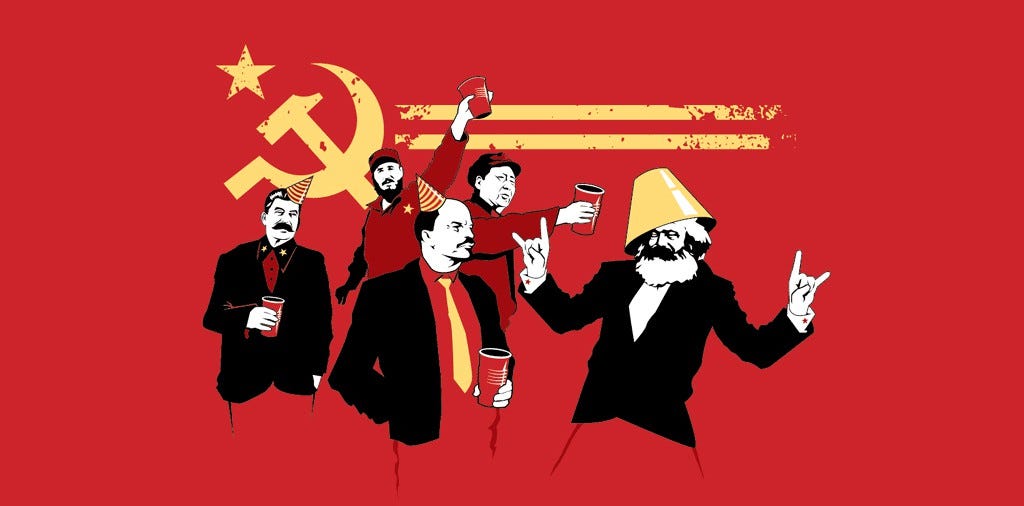
To understand the mechanics of the modern Champagne Socialist, one must look through the lens of status signaling. In past decades, the elite signaled their position through conspicuous consumption, showcasing luxury cars, haute couture, and country estates. However, as material goods have become more widely accessible, the truly affluent have pivoted to a new currency based on luxury beliefs. A luxury belief is an opinion or conviction that confers status on the wealthy, while the actual costs of holding that belief are externalised and borne entirely by the lower classes.
When a multi-millionaire media executive or a Kensington-dwelling academic advocates for aggressive eco-taxes, open borders, or the dismantling of traditional civic institutions, they suffer zero material consequences. The elite remain completely insulated, residing in gated communities, sending their children to private schools, and possessing the capital to absorb skyrocketing energy bills or increased taxation. For the working-class family in the Midlands, those same policies manifest as redundant manufacturing jobs, stagnant wages, and unaffordable heating costs. The radical ideology is, in essence, a luxury product. The elite get the moral high ground and the social adulation, while the proletariat receives the bill.
The psychological utility of Champagne Socialism cannot be overstated. Capitalists of the Victorian era were at least honest about their pursuit of profit. The modern corporate aristocrat, however, suffers from a profound sense of class guilt. Adopting radical leftist positions serves as an effective cloaking mechanism. By loudly demanding to tax the rich or declaring capitalism inherently evil from a lecture podium or a tech conference stage, the wealthy individual psychologically divorces themselves from their own privilege. They are no longer part of the oppressor class; they are part of the resistance.
This creates a bizarre spectacle where billionaires, multinational corporations, and legacy media institutions align themselves with Marxist rhetoric. It is a brilliant defensive strategy. By co-opting the language of revolution, the establishment immunises itself against actual systemic critique. If the corporate board is sufficiently progressive, the underlying exploitation remains conveniently unexamined.
Perhaps the most damaging pitfall of this phenomenon is the structural damage it inflicts upon genuine working-class movements. Historically, the British Labour movement was rooted in material realities, focusing on wages, working conditions, housing, and tangible community stability. When the Champagne Socialist faction takes the reins of a left-leaning movement, the priorities inevitably shift from the material to the abstract.
Where the traditional working-class left prioritized material conditions, jobs, and public services, the modern champagne left fixates on identity politics, cultural discourse, and globalist policy. The traditional view sought the protection of local industry and domestic labour, whereas the salon left focuses on theoretical wealth redistribution via heavy bureaucracy. Even the language changes, shifting from plain, accessible, community-focused speech into academic jargon and exclusionary syntax designed to signal virtue.
Because the affluent leftist does not have to worry about paying rent or finding a secure job, they naturally pivot the political discourse toward abstract, cultural battlegrounds. The language of the movement becomes highly academic, exclusionary, and alienating to the average citizen. The working class finds itself politically disenfranchised. They look to the left and see a movement dominated by affluent urbanites who view them not as a constituency to be served, but as an uneducated mass to be enlightened. This alienation explains the massive realignment witnessed across the Western political landscape, where the traditional working class has abandoned left-wing parties in droves.
At its core, Champagne Socialism relies on a fundamental ignorance of economic reality. The policy prescriptions advanced by the salon left almost universally involve the expansion of state power, increased regulatory burdens, and aggressive taxation. The irony is that these policies systematically crush small businesses and independent enterprises, which lack the legal and financial infrastructure to navigate complex regulatory environments. Conversely, multinational corporations absorb the regulations with ease, weaponising compliance costs to destroy their smaller competitors.
Furthermore, the obsession with top-down redistribution overlooks a basic truth, which is that wealth must be generated before it can be confiscated. The Champagne Socialist, comfortably ensconced in non-productive sectors like media, NGOs, or academia, views the economy as a fixed pie to be divided by benevolent bureaucrats. They disregard the fragile ecosystem of risk, capital investment, and innovation required to sustain economic growth.
Champagne Socialism is fundamentally a parasitic relationship. It feeds on the genuine grievances of the economically disadvantaged to generate moral capital for the affluent. It offers the working class nothing but empty rhetoric, an elevated cost of living, and cultural alienation, all while securing the status and privilege of the elite. Until political movements reject the performative virtue of the salon radicals and return to the grounded, material realities of the working populations they claim to represent, the socio-economic divide will only widen.